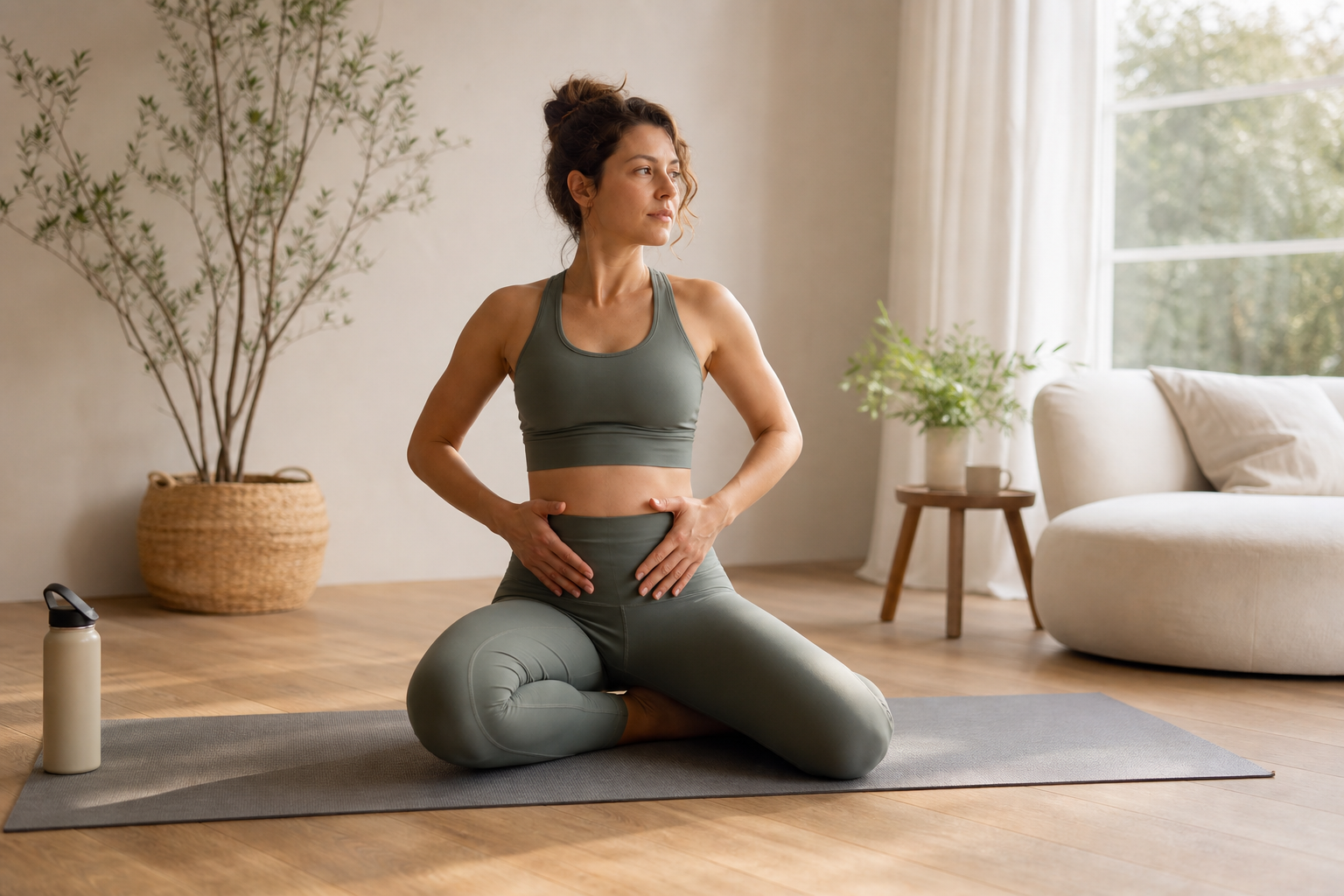
If you’ve had a baby in the last two years and you’ve tried to get back into shape, you’ve probably noticed something nobody warned you about: the program you used to love doesn’t work the same way anymore.
You feel weaker than expected. Things leak when they shouldn’t. Your core feels disconnected, like there’s a gap between intention and movement. And the workouts you see online — the bouncing, the planks, the burpees — feel wrong, even when you can technically do them.
That’s not a failure of motivation. That’s your body trying to tell you that the foundation isn’t ready yet.
Why the usual postpartum advice fails
Open any major fitness app, search “postpartum workout,” and you’ll find programs that start somewhere around week 6 with squats, planks, and “core blasts.” It’s well-intentioned. But it skips the system that should be addressed before any of those exercises become safe or effective.
That system is your pelvic floor.
Your pelvic floor is a hammock of muscle that sits at the base of your core. During pregnancy, it stretched and bore enormous load. During delivery, it likely tore, was cut, or was significantly traumatized — even by a textbook birth. After delivery, it’s not just “weak.” It’s deconditioned, often desynchronized from your breathing, and frequently still in a state of subtle inflammation.
If you train abs and glutes before retraining the pelvic floor, three things happen:
- Your body recruits compensation patterns that hide the dysfunction
- Symptoms (leaks, heaviness, prolapse signs) get worse, not better
- You build strength on a base that isn’t actually there
The visible results come faster on the surface. The dysfunction gets buried deeper.
What works and why
The order matters more than the intensity. A real postpartum program starts where the body actually starts: breath, alignment, and pelvic floor reactivation. Then, and only then, you progress to deep core, glutes, and full-body movement.
Here’s the principle: your pelvic floor coordinates with your diaphragm. They form a pressure system. If you breathe well — diaphragm down on inhale, pelvic floor releases; diaphragm up on exhale, pelvic floor lifts — you’re already retraining the system. You don’t need fancy equipment. You don’t need apps. You need attention.
The biggest mistake I see is women doing 100 kegels a day and wondering why nothing changes. Kegels in isolation don’t work because the pelvic floor isn’t a single muscle you flex on demand. It’s part of a coordinated system that responds to breath, posture, and load. Train the system, not the muscle.
Your pelvic floor isn’t broken. It’s deconditioned and out of sync. Those are two very different problems with very different solutions.
How to actually do it
The first four weeks postpartum are about reconnection, not exercise. Whether you’re at week 6 or week 60, if you skipped this phase, go back and do it now. It’s never too late.
-
Diaphragmatic breathing, lying on your back, 5 minutes a day. Hand on belly, hand on chest. Inhale through the nose, belly rises and chest stays still. Exhale through pursed lips, belly falls. The pelvic floor naturally rises on the exhale. Do this until it feels like a single coordinated wave.
-
Pelvic tilts, on your back, knees bent, 10 reps a day. Press the lower back gently into the floor on exhale, release on inhale. This re-teaches your spine and pelvis to talk to each other. Sounds tiny. It’s not.
-
Glute bridge with breath coordination, 2 sets of 10. Exhale as you lift, drawing the pelvic floor up with the lift. Inhale as you lower. The breath is the program here, not the bridge itself.
-
Standing alignment check, 30 seconds, several times a day. Ribs stacked over hips. Don’t tuck your butt. Don’t flare your ribs. Most postpartum dysfunction is invisible posture leaking energy and causing strain.
-
Walk daily, even 10 minutes. Walking restores the natural rotational rhythm of the pelvis and gently loads the system. Don’t underestimate it.
That’s it for the first phase. You’ll know you’re ready to progress when you can do all five without fatigue, without symptoms, and without losing breath coordination.
What to avoid
- Crunches and sit-ups in the first 12 weeks postpartum (and longer if you have diastasis)
- Heavy lifting before your pelvic floor responds to breath cues
- High-impact exercises (running, jumping, HIIT) before phase 2
- Six-pack abs videos and “snap back” promises — they’re selling you a fantasy that’s actively harmful
The real win
When you do this right, the rebuild stacks instead of compensates. You don’t just look stronger eventually — you actually are stronger, in the way that matters. Your core supports your spine. Your pelvic floor supports your organs. Your breath supports your output. The whole system is integrated.
Six months in, you’ll notice things most postpartum women never get back: lifting your toddler without strain, running without leaking, feeling solid in your body again. That’s not a marketing promise. That’s what happens when you stop skipping foundations.
Trust the process. Trust your body. We start at the floor and build up.
— Laet