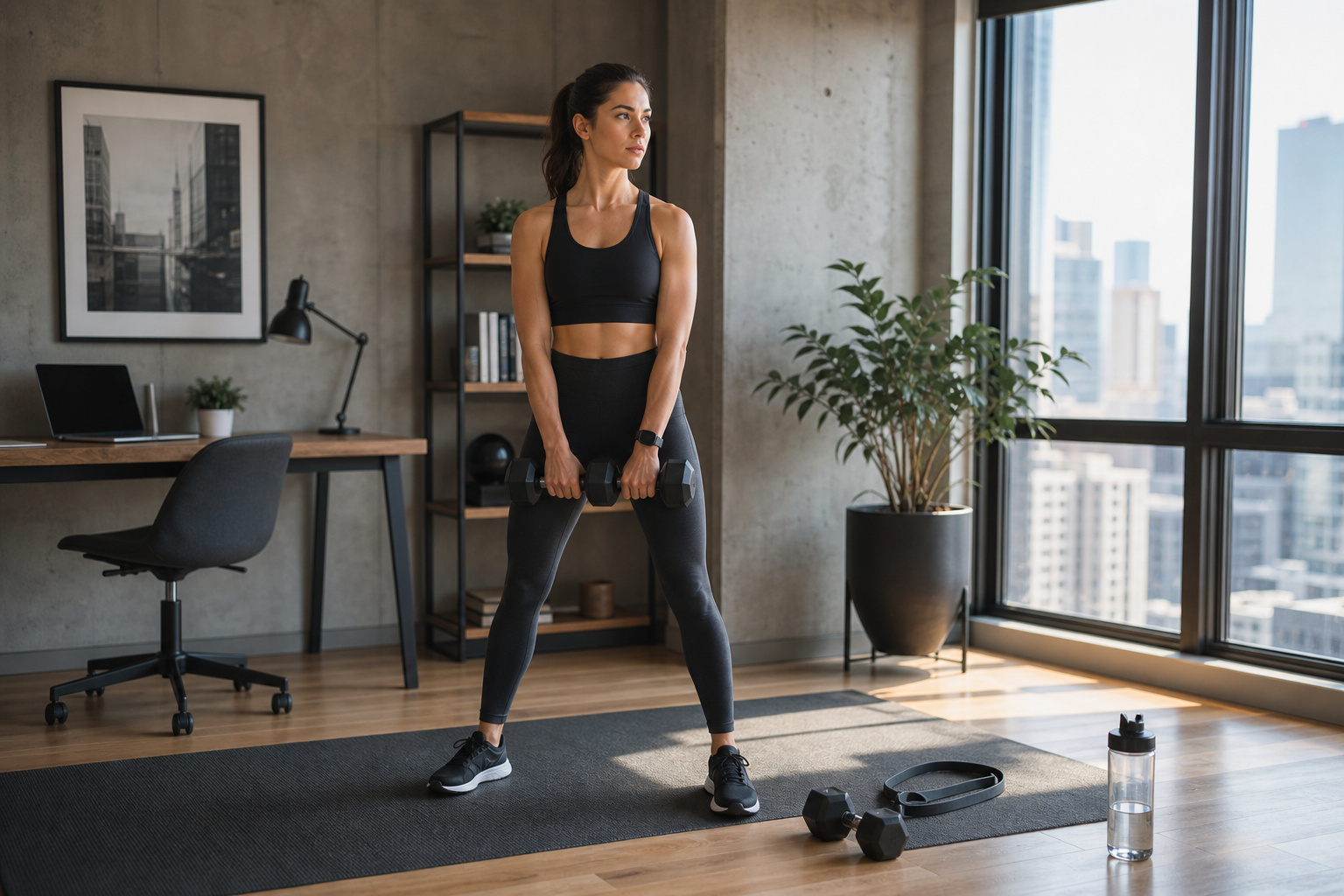
If your time at the gym is limited, you don’t need a more complicated program. You need a simpler one.
Most workout splits are designed for people whose job is fitness — they have hours to dedicate, and they enjoy variety. For everyone else, especially anyone with a real job and a life, the answer isn’t more exercises. It’s a smaller list of better exercises done well, repeatedly, for years.
Here are the five.
Why these five
Each of these movements does something that no isolation exercise can: it loads multiple muscle groups simultaneously, demands coordination, and challenges your nervous system. That last part is what produces real results in less time. Isolation exercises are fine, but they’re dessert, not the main course.
When you do a squat, you’re training your quads, glutes, hamstrings, calves, core, lower back, and your nervous system’s ability to coordinate the whole chain. That’s why ten squats with weight does more for you than thirty leg extensions.
Compound movements are time machines. They give you the strength of someone who trained twice as long.
The five
1. Squat
Trains: quads, glutes, hamstrings, core, balance.
Why it matters: it’s how you stand up from a chair, climb stairs, and pick up your kid. If your squat goes, your independence eventually goes with it. Every adult should be able to squat their bodyweight to parallel for 5 reps.
Variations to grow into: bodyweight → goblet squat with dumbbell → barbell back squat → front squat. Most people never need to go past goblet squat with serious weight.
What to watch: knees tracking over toes, chest up, depth honest (parallel or below if mobility allows).
2. Hinge (deadlift family)
Trains: hamstrings, glutes, lower back, core, grip.
Why it matters: it’s how you pick anything off the ground. The hinge pattern is the most under-trained movement in modern adults — we sit, so our posterior chain forgets how to work. Restoring it fixes back pain, improves posture, and protects you in every other lift.
Variations: Romanian deadlift with dumbbells → kettlebell deadlift → barbell deadlift. Start light. Form is everything.
What to watch: neutral spine (not rounded), bar travels straight up the legs, hips drive the movement, not the back.
3. Push (push-up or press)
Trains: chest, shoulders, triceps, core stability.
Why it matters: pushing strength fades fast in adults. It’s how you brace yourself when you fall. It maintains shoulder integrity and posture. Most working adults have weak push strength because they spend the day pulling forward (laptop posture).
Variations: incline push-up → push-up on knees → full push-up → bench press → overhead press.
What to watch: in push-ups, body in a straight line (no sagging hips); in pressing, ribs stacked over hips, no flaring.
4. Pull (row or pull-up)
Trains: back, biceps, rear shoulders, grip.
Why it matters: pulling is the antidote to the desk-worker posture epidemic. Strong upper back muscles support the spine, prevent neck pain, and balance the chest work that’s already built into modern life.
Variations: bent-over dumbbell row → seated cable row → assisted pull-up → pull-up.
What to watch: pull with the back, not the arms; squeeze the shoulder blades; no shrugging up to the ears.
5. Carry (loaded carry)
Trains: core, grip, shoulder stability, posture, conditioning.
Why it matters: this is the most underused movement in the modern gym. Walking with weight forces your entire body to brace and stabilize. It builds real-world strength faster than any single exercise. It’s also the closest thing to “functional movement” that actually deserves the name.
Variations: farmer’s carry (dumbbells in each hand) → suitcase carry (one hand) → overhead carry → bear hug carry.
What to watch: stay tall, ribs stacked, breathe through it, take small fast steps. Distance over speed.
How to actually train them
You don’t need to do all five every session. A simple, durable structure:
- Day 1: Squat + Push + Carry
- Day 2: Hinge + Pull + Carry
- Day 3: Squat + Pull + Hinge
Three sessions a week. 30–40 minutes. Three to four sets of each main lift, 5–10 reps depending on the load. Generous rest between sets (2 minutes for heavier work). Add accessories only if you have time and energy left.
Stay on this for six months. Add weight when the current weight feels easy, not before. The progression is the point. Don’t switch programs every three weeks looking for variety. Variety is for people who already have a strong base.
What to avoid
- Skipping these in favor of cable machines because they “feel safer”
- Adding so many accessory exercises that the compounds get rushed
- Going heavy with bad form to chase weight on the bar
- Switching programs every six weeks
- Avoiding the lifts you’re worst at (those are usually the ones you need most)
The real win
Build a base on these five for one year and you’ll have more functional strength than people who’ve been training inconsistently for ten. You’ll move better. You’ll have less injury risk. You’ll spend less time in the gym, not more.
The question isn’t “what’s the best workout for me?” It’s “what’s the simplest program I’ll actually do, every week, for the next two years?” These five answer that question better than any plan with twenty exercises.
Pick the basics. Get strong. Stay strong.
— Laet