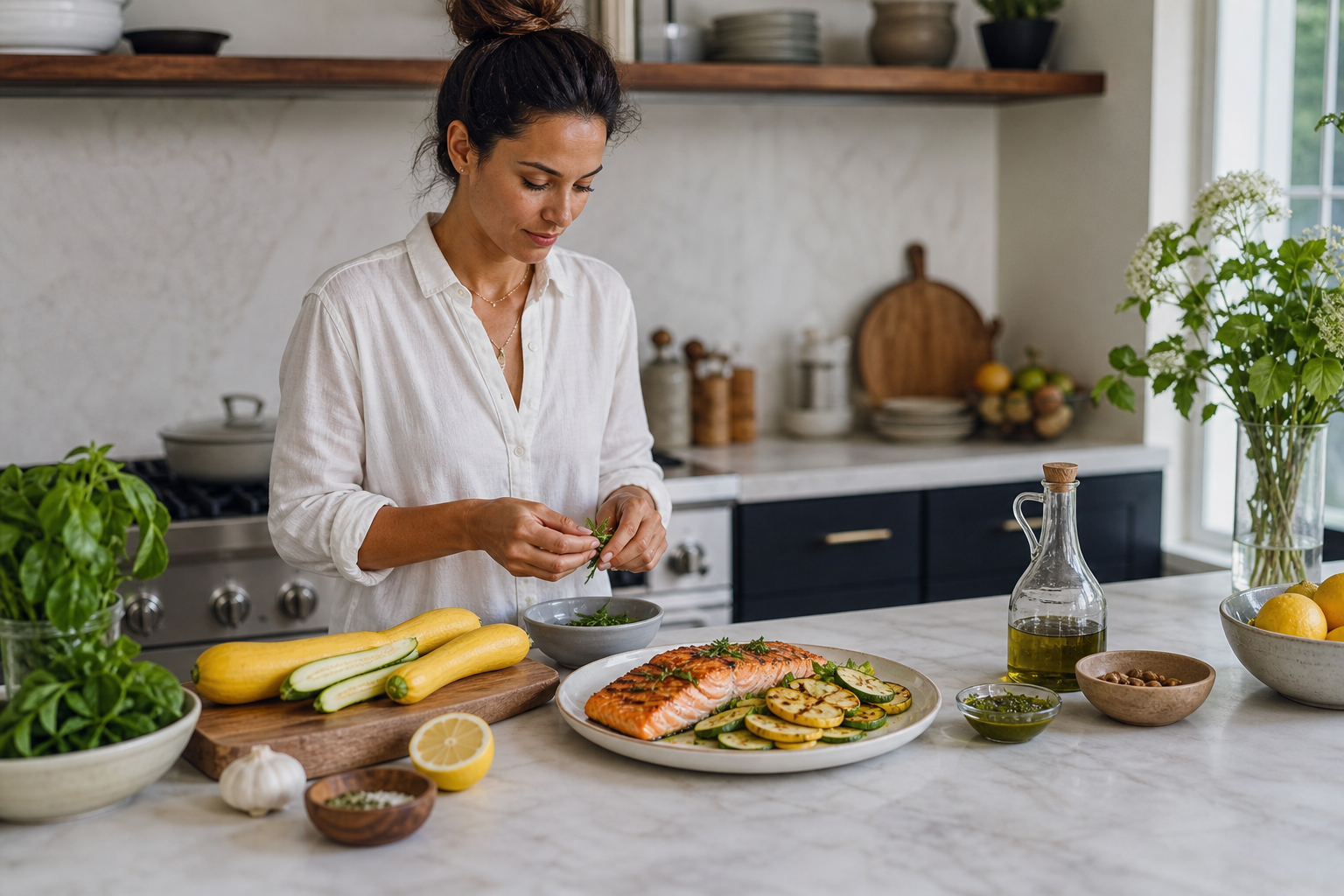
July in the Pacific Northwest means farmer’s market squash that doesn’t taste like cardboard, late sunsets, and training sessions that leave you depleted in ways a protein shake won’t fix. You need food that fights inflammation, rebuilds muscle, and doesn’t require you to stand over a stove when it’s 78 degrees at 7 p.m.
This isn’t a “clean eating” recipe. It’s a performance meal that happens to be anti-inflammatory, takes 25 minutes, and uses ingredients you can grab on a normal grocery run.
Why this recipe right now
Summer squash peaks in July — zucchini, yellow squash, pattypan if you’re lucky. They’re high in vitamin C, potassium, and water content, which matters when you’re sweating through tempo runs or strength sessions in the heat. Pair that with wild-caught salmon (omega-3s for joint health and muscle recovery) and you’ve got a meal that actively reduces post-training inflammation instead of just “not making it worse.”
The herb oil isn’t garnish. Fresh herbs — basil, parsley, cilantro — contain polyphenols that support recovery. Olive oil helps you absorb fat-soluble vitamins A and K from the squash. This is food that works with your body, not against it.
Ingredients
For 4 servings:
- 4 salmon fillets (5-6 oz each, skin-on, wild-caught if possible)
- 3 medium summer squash (mix of zucchini and yellow), sliced into ½-inch rounds
- 2 tablespoons olive oil
- 1 teaspoon sea salt
- ½ teaspoon black pepper
- 1 lemon (zested and juiced)
- ¼ cup fresh herbs (basil, parsley, or cilantro — your choice)
- 2 garlic cloves
- 3 tablespoons extra virgin olive oil (for the herb oil)
- Optional: ¼ teaspoon red pepper flakes
How to make it
Total time: 25 minutes
-
Preheat your grill or grill pan to medium-high. If you’re using a sheet pan under the broiler, set it to high and position the rack 6 inches from the heat source.
-
Prep the squash. Toss sliced squash with 2 tablespoons olive oil, half the salt, and black pepper. Spread on a sheet pan or grill basket in a single layer.
-
Season the salmon. Pat fillets dry. Rub with lemon zest, remaining salt, and a drizzle of olive oil. Let sit while you start the squash.
-
Grill the squash first. 4-5 minutes per side until charred and tender. Remove and set aside. Now add the salmon, skin-side down. Grill 4-5 minutes, flip carefully, cook another 3-4 minutes until just opaque in the center.
-
Make the herb oil while everything cooks. Roughly chop herbs and garlic. Combine with 3 tablespoons olive oil and lemon juice in a small bowl. Mash with a fork or pulse in a blender for 10 seconds if you want it smoother.
-
Plate and finish. Squash on the bottom, salmon on top, herb oil drizzled over everything. Serve immediately.
What this gives you
Each serving delivers roughly 35g protein, 18g fat (mostly omega-3 and monounsaturated), 8g carbs, and 3g fiber. That’s a complete amino acid profile for muscle repair, anti-inflammatory fats that actually move the needle on joint health, and enough micronutrients (vitamins A, C, K, potassium, magnesium) to support recovery without needing a supplement stack.
The salmon provides EPA and DHA — the omega-3s your body can actually use, not the stuff from flax that requires conversion. Summer squash is low-glycemic and hydrating, which matters when you’re training in heat. The herb oil adds polyphenols and makes this taste like something you’d order at a restaurant, not something you choked down because it’s “healthy.”
Variations
If you have extra time: Add cherry tomatoes to the sheet pan with the squash. They’ll blister and add acidity that cuts the richness of the salmon.
No time for herb oil: Skip it. Squeeze lemon directly over the cooked fish and squash, add a handful of torn fresh basil. Done.
For a high-volume training day: Serve over ¾ cup cooked quinoa or farro per person. Adds 25g carbs and turns this into a full glycogen-replenishing meal.
The real win
You don’t need a perfect meal plan. You need three or four meals you’ll actually make on a Tuesday night when you’re tired, slightly sore, and out of decision-making capacity. This is one of those meals.
It’s fast enough that you won’t default to takeout. It’s satisfying enough that you won’t be hunting for snacks an hour later. And it’s built around real food that supports the work you’re doing in the gym, on the trail, or in your living room.
Discipline beats motivation, every single day.
A 25-minute meal you make twice a week will always outperform the elaborate plan you execute once and then abandon. This is the former.
— Laet